


Explore how AI is revolutionizing mobile app development with machine learning, chatbots, predictive insights, and intelligent automation across industries.
- The Evolution of Mobile App Development with AI
- Core AI Technologies Powering Mobile Applications
- There are various technologies of AI that contribute to the transformation of mobile apps into smart business tools.
- Use cases of machine learning include:
- As more data about users accumulates, machine learning models become better, making applications more efficient.
- Use cases of Natural Language Processing include:
- The technology helps to improve relations with customers and saves human effort.
- Typical use cases of computer vision include:
- Healthcare, retail, manufacturing, and security industries heavily rely on computer vision.
- How AI is Revolutionizing Mobile App Development
- Benefits of AI-Powered Application Development for Businesses
- Industry Applications of AI in Mobile Development
- Retail and E-commerce: Retail companies employ AI to provide
- These lead to better customer experience and higher sales figures.
- Banking and Finance: Banks employ AI technology to help in
- It enhances the security as well as efficiency in operations.
- Education: The uses of AI in education include
- Personalized learning
- Students get personalized learning according to their progress.
- Logistics and Transportation: The role of AI in logistics includes:
- This leads to quick deliveries at lower costs.
- AI Across the Mobile App Development Lifecycle
- Challenges of AI Integration
- Best Practices for Successful AI Mobile Applications
- The Future of AI in Mobile Applications
- Conclusion
Today artificial intelligence (AI) is not only a future technology-it is becoming one of the most important factors affecting the development of the mobile applications market. Companies dealing with healthcare, financial services, retail, logistic services, educational services and entertainment use AI for improving mobile applications in terms of personalization, automation and increasing efficiency.
In such a way the need for intelligent solutions drastically affects the process of planning, designing, developing and maintaining mobile applications. Modern companies try not to focus on the development of regular mobile applications but pay attention to the creation of those which can learn from users’ behavior, make intelligent decisions and improve performance.
It means that any progressive mobile application development company has to implement AI features in its development approach.
The Evolution of Mobile App Development with AI
Older mobile applications were created to do certain tasks in accordance with their predetermined programming logic. These apps were effective but at times rigid and lacked adaptability.
Modern AI-based mobile applications learn from users’ actions, recognize patterns, automate routine processes, and offer relevant suggestions according to the latest data. The apps are not only responsive but also gradually become smarter.
Regardless of whether it is product recommendation, voice command recognition, fraud detection, customer behavior prediction, or automated customer support, AI allows for smarter interactions.
As a result, AI is becoming an indispensable element of any modern mobile app development process.
Core AI Technologies Powering Mobile Applications
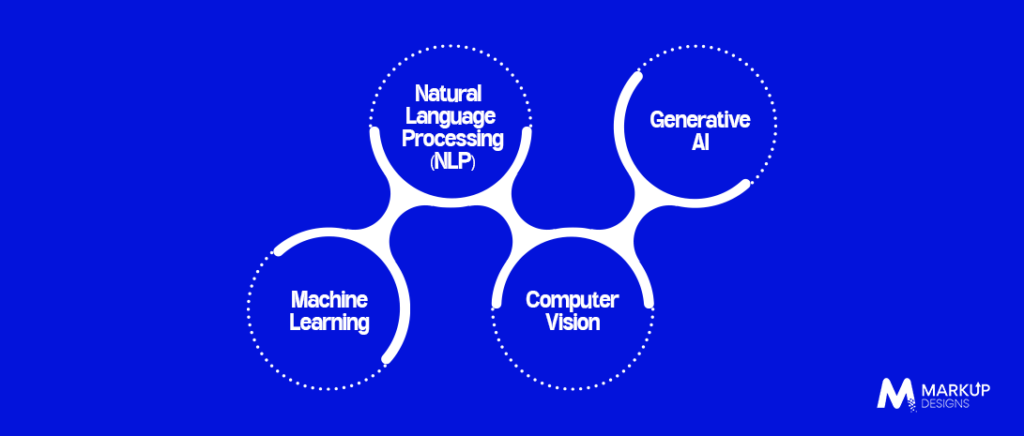
There are various technologies of AI that contribute to the transformation of mobile apps into smart business tools.
Machine Learning: Machine Learning allows an application to learn from previous data without needing to update the application program.
Use cases of machine learning include:
- Personalized recommendations
- Predictive analytics
- Segmentation of customers
- Fraud detection
- Demand forecasting
As more data about users accumulates, machine learning models become better, making applications more efficient.
Natural Language Processing (NLP): Natural Language Processing allows mobile applications to process human language.
Use cases of Natural Language Processing include:
- AI chatbots
- Virtual assistants
- Smart search
- Translation of languages
- Sentiment analysis
The technology helps to improve relations with customers and saves human effort.
Computer Vision: Computer Vision allows mobile applications to analyze pictures and videos.
Typical use cases of computer vision include:
- Facial recognition
- Object detection
- Scanning QR codes
- Analysis of medical images
- Visual search of products
Healthcare, retail, manufacturing, and security industries heavily rely on computer vision.
Generative AI: Generative AI is emerging fast as one of the most disruptive technologies in mobile app development.
Its uses include the following:
- Generating content
- Personalized responses
- Writing assistance
- Image generation
- Summaries
- Increased customer interaction
It brings a whole new set of possibilities in the realm of intelligent mobile apps.
How AI is Revolutionizing Mobile App Development
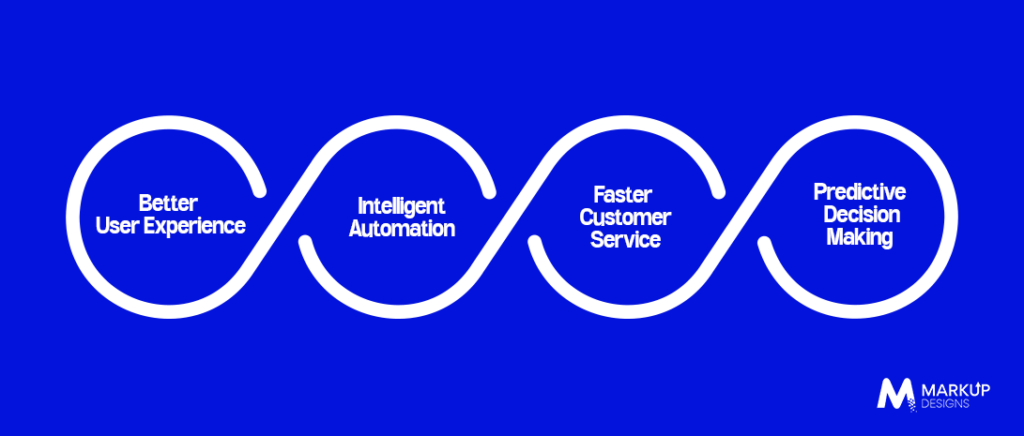
Artificial intelligence is transforming every stage of the development lifecycle.
Better User Experience: Today user experience has become one of the key differentiators in the mobile app marketplace.
Based on user behavior, preferences, location, search history, and purchase behavior, AI delivers highly personalized experiences.
Examples:
- Personalized content feeds
- Product recommendations
- Custom notifications
- Intelligent search
- Dynamically adjusting interfaces
Through personalization, user engagement and retention have increased tremendously.
Intelligent Automation: There are numerous business processes that can be automated by leveraging AI.
Through automation, mobile applications are able to:
- Process user requests
- Schedule meetings
- Validate documents
- Routing support requests
- Business intelligence
- Reporting
Costs can be decreased while increasing the quality of service.
Faster Customer Service: Chatbots powered by AI instantly help customers 24/7.
Contrary to traditional support systems, AI chatbots understand the user’s intent and generate contextual responses and continue learning through machine learning.
The benefits include:
- Increased efficiency
- Decreased costs
- Increased customer satisfaction
- Improved scalability
Predictive Decision-Making: Unlike typical applications that just show historical data, AI-based applications predict the future.
Through predictive analytics businesses can
- Forecast demand
- Predict churn
- Optimize stock
- Improve marketing campaigns
- Reduce operational risks
Benefits of AI-Powered Application Development for Businesses
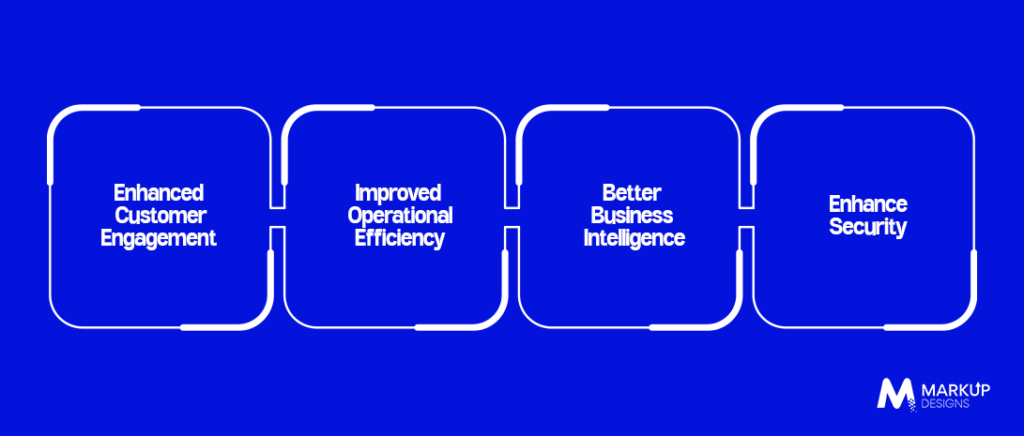
Implementation of AI-powered application development provides business benefits.
Enhanced Customer Engagement: AI helps provide a very personalized experience making users engage more with applications.
Recommendations, notifications, and interfaces tailored to each user make customers happier and increase their loyalty.
Improved Operational Efficiency: AI takes care of mundane tasks, enabling the workers to concentrate on more important aspects of the business.
This results in:
- Decreased operational expenses
- Improved processing speed
- Fewer mistakes
- Greater productivity
Better Business Intelligence: The AI analyzes large quantities of structured and unstructured data on a real-time basis.
These organizations get insights which enable them to do:
- Market analysis
- Forecast sales
- Analyze customer behavior
- Optimize products
- Monitor performance
Enhance Security: Today, cybersecurity is a critical area of concern for companies building mobile apps.
AI helps enhance app security in a number of ways, including:
- Suspicious activity detection
- Fraud detection
- User behavior monitoring
- Unauthorized access prevention
- Real-time security threat response
Industry Applications of AI in Mobile Development
AI is creating value across virtually every industry. AI-Powered Healthcare is one of the most impactful areas of transformation.
Healthcare: Healthcare applications leverage AI for
- Remote patient monitoring
- Medical image analysis
- Virtual consultations
- Appointment scheduling
- Health predictions
These capabilities improve patient care while reducing administrative workload.
Retail and E-commerce: Retail companies employ AI to provide
- Product recommendation
- Visual product search
- Inventory management
- Dynamic pricing
- Personalized offers
These lead to better customer experience and higher sales figures.
Banking and Finance: Banks employ AI technology to help in
- Fraud detection
- Credit scoring
- Risk assessment
- Automated customer service
- Finance planning
It enhances the security as well as efficiency in operations.
Education: The uses of AI in education include
Personalized learning
- Automatic assessment
- Smart tutoring
- Learning analytics
- Virtual classroom
Students get personalized learning according to their progress.
Logistics and Transportation: The role of AI in logistics includes:
- Optimized routes
- Fleet management
- Scheduling deliveries
- Forecasting demand
- Warehousing
This leads to quick deliveries at lower costs.
AI Across the Mobile App Development Lifecycle
Artificial intelligence affects every stage of development.
Planning: AI evaluates market trends, consumer behavior, and competitive analysis in order to identify opportunities prior to development.
Design: AI-powered tools for design can be used in order to build interfaces based on behavioral insights.
Development: Programmers regularly utilize AI-based programming tools to perform automation and debugging.
Testing: AI supports the process of automated testing via defect detection, predicting possible defects, and generating test cases.
Maintenance: After developing the application, AI helps you to monitor its performance, crashes, user behavior, and security.
Challenges of AI Integration
However, despite these benefits, implementation of AI is not without challenges.
Some of these include:
- Data privacy issues
- Need for good quality training data
- Compatibility with existing systems
- Model accuracy
- Compliance issues
- Infrastructure costs
The success of AI implementation depends on having clearly defined goals and proper development.
Best Practices for Successful AI Mobile Applications
Businesses can ensure success of their use of artificial intelligence with the help of following some best practices.
- State concrete business goals.
- Gather quality and credible data.
- Focus on preserving the privacy and security of the user.
- Utilize scalable cloud computing.
- Educate the AI continuously.
- Watch out for the application after its release.
- Perform security assessments often.
- Solve customers’ problems rather than relying only on artificial intelligence technology.
The Future of AI in Mobile Applications
The future belongs to artificial intelligence in mobile applications.
Advances in technology such as multimodal artificial intelligence, edge artificial intelligence, autonomous agents, real-time language translation, emotional intelligence, and hyper-personalization will further increase the intelligence of users’ experience.
Companies that invest in artificial intelligence now will find themselves better equipped for coping with future changes in customer needs and business demands.
Instead of taking away from human skills, artificial intelligence is an effective means of increasing efficiency and making better decisions.
Conclusion
AI has revolutionized how mobile apps are developed and experienced. Through intelligent automation, personalization, predictive analytics, and improved security, among others, artificial intelligence is used by companies to develop innovative and efficient mobile apps that provide excellent experiences to users.
With the growing importance of digital transformation, firms that invest in artificial intelligence technology will be in a good position to satisfy customers and improve on their processes. Working with a well-experienced mobile app development company will go a long way in ensuring successful implementation of artificial intelligence technology.
