
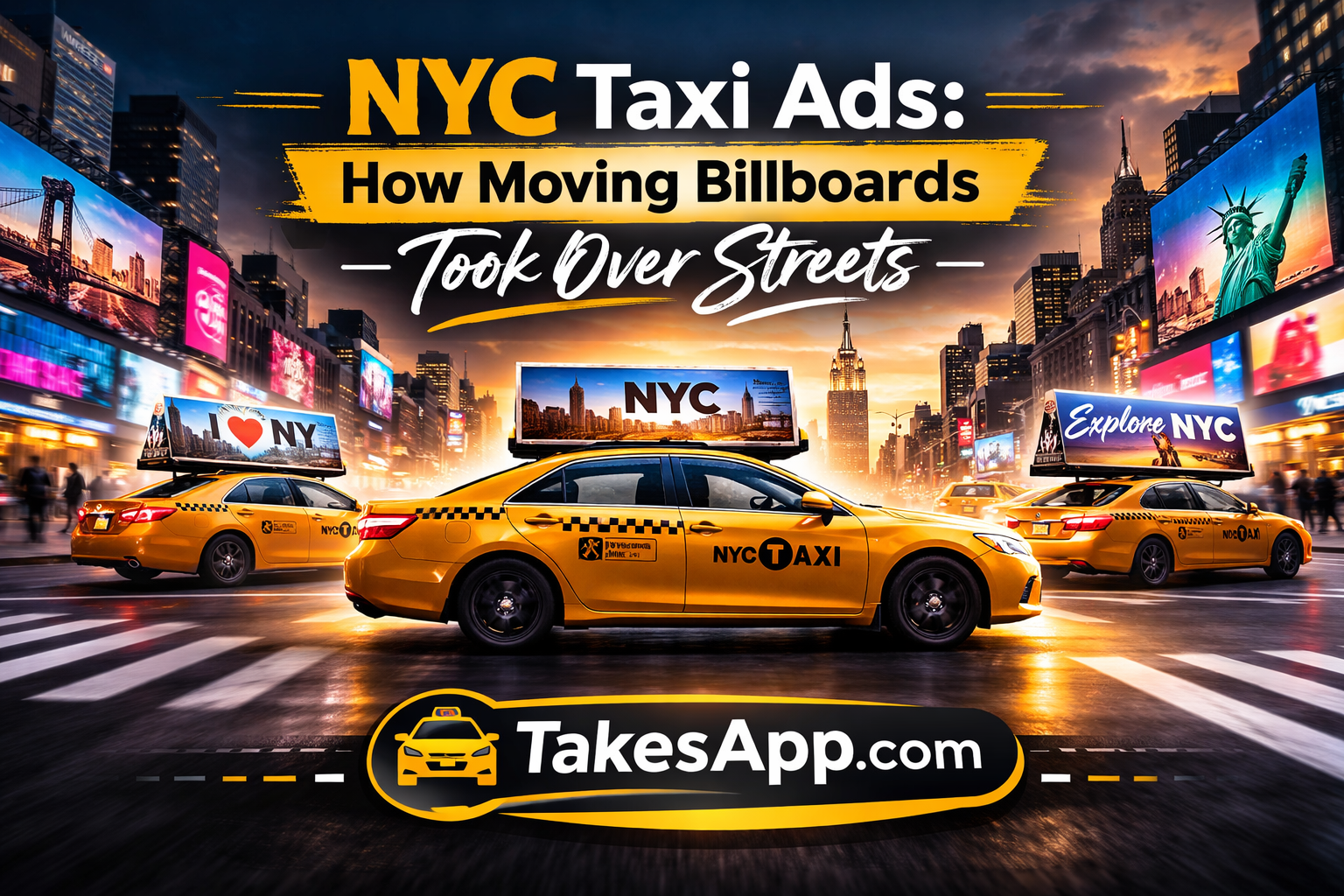

If you’ve spent even a short time in Manhattan, you’ve probably noticed the glowing screens on top of yellow taxis. These are part of the growing New York taxi ads ecosystem, a form of mobile out-of-home advertising that has become extremely popular in recent years. Instead of relying only on static billboards, brands are increasingly turning to taxis that move through the busiest parts of the city, carrying digital ads wherever they go.
In a city where millions of people walk the streets every day, mobility is incredibly valuable. A single taxi can pass through business districts, tourist areas, nightlife zones, and residential neighborhoods in the same day. This constant movement turns taxis into powerful advertising vehicles that reach a wide variety of audiences.
Why Taxi Advertising Works So Well in New York
New York City is one of the most crowded and active cities in the world. Every day, thousands of taxis circulate through Manhattan, Brooklyn, Queens, and other boroughs. Because of this constant traffic, taxi advertising offers a level of exposure that is difficult to achieve with many other types of outdoor media.
Unlike traditional billboards that stay in one place, taxi ads travel through the city and appear in front of different audiences throughout the day. A taxi might drive past office workers in Midtown during the morning, tourists in Times Square in the afternoon, and restaurant crowds in SoHo during the evening.
This variety of exposure makes taxi ads especially valuable for brands trying to reach multiple demographic groups across the city.
Another advantage is visibility. The digital screens mounted on taxi roofs are designed to be bright and noticeable, especially at night when many parts of New York remain busy and active. Because taxis frequently stop at traffic lights or in slow-moving traffic, pedestrians and drivers often have enough time to actually read and remember the advertisement.
The Evolution From Static Taxi Ads to Digital Screens
Taxi advertising has existed for decades, but it has changed significantly in recent years. In the past, most taxi ads were printed panels placed inside a frame on the vehicle roof. These printed ads worked well, but they had one major limitation: they could not change quickly.
Whenever a brand wanted to launch a new campaign, the physical panels had to be replaced manually. This process took time and limited how flexible campaigns could be.
Digital taxi tops completely changed the model. Instead of printed panels, modern taxi ads use LED screens connected to a central network. Advertisers can now upload new creative content remotely, update campaigns instantly, and run multiple ads in rotation throughout the day.
For example, a campaign could show one ad during the morning commute and a completely different message later in the evening when nightlife areas become busy.
Location-Based Advertising in a Moving City
One of the most interesting aspects of modern taxi advertising is the use of location data. Many digital taxi advertising platforms use GPS technology to track where vehicles are operating throughout the city.
This allows campaigns to be scheduled or optimized based on location. Ads displayed near financial districts during weekday mornings might promote financial services or business tools, while ads appearing near entertainment districts in the evening might promote concerts, restaurants, or events.
Because taxis constantly move between neighborhoods, advertisers can reach a variety of audiences without needing dozens of different billboard locations.
Data and Measurement in Outdoor Advertising
In the past, measuring the effectiveness of outdoor advertising was difficult. Marketers often relied on general estimates about how many people might pass by a billboard each day.
Today, digital taxi advertising networks can provide much more detailed insights. Campaigns can be tracked based on taxi routes, estimated impressions, and exposure time in different parts of the city.
This data-driven approach makes taxi advertising more appealing to brands that are used to measuring results from digital marketing channels such as search or social media. While outdoor ads are still fundamentally visual and brand-focused, the availability of data helps advertisers better understand the reach and impact of their campaigns.
Why Brands Continue to Invest in Taxi Ads
As online advertising becomes more crowded, many companies are rediscovering the value of physical advertising spaces. Outdoor media provides a type of visibility that digital ads on phones or computers cannot always match.
Taxi advertising combines the strengths of both worlds. It delivers large, highly visible ads in the real world while also offering digital flexibility and campaign control.
For brands launching new products, promoting events, or building awareness in major cities, taxi ads provide a unique way to stand out in a crowded media landscape.
The Future of Taxi Advertising in New York
Looking ahead, taxi advertising will likely continue evolving as technology improves. More advanced targeting, better analytics, and smarter campaign management tools will make it easier for advertisers to run highly optimized campaigns across entire cities.
Artificial intelligence and real-time data may also play a larger role in deciding which ads appear in specific locations or at certain times of day.
In a fast-moving city like New York, advertising that moves with the audience simply makes sense. As brands continue searching for new ways to capture attention, taxi advertising will remain an important part of the urban marketing landscape.
