
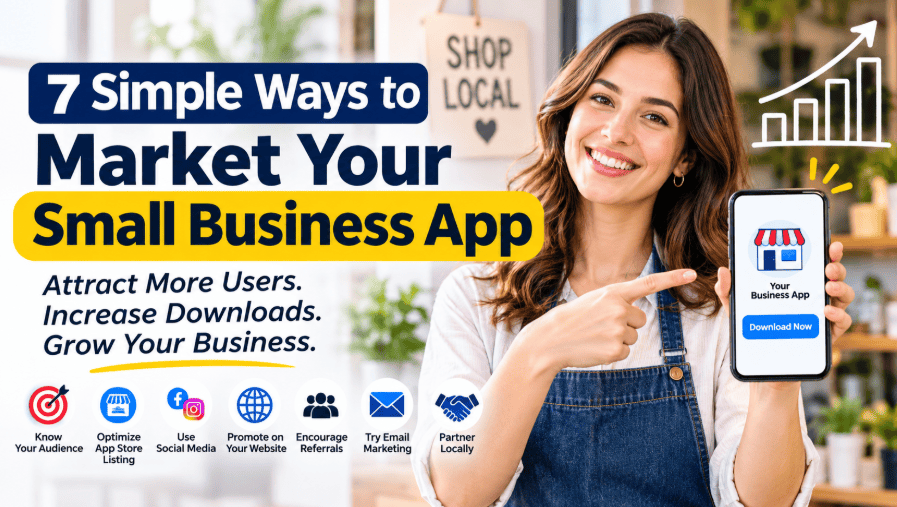

Discover seven practical ways to market a small business app, attract users, increase downloads, and build lasting customer loyalty.
- 1. Understand Your Target Audience Before Promoting Your App
- 2. Improve Your App Store Listing With ASO
- 3. Use Social Media to Build App Awareness
- 4. Promote Your Small Business App Through Your Website
- 5. Create a Customer Referral Program
- 6. Use Email Marketing to Encourage Downloads and Engagement
- 7. Collaborate With Local Businesses and Influencers
- Measure Your App Marketing Performance
- Conclusion
- Frequently Asked Questions (FAQs)
- 1. How do I market a small business app successfully?
- 2. How can I promote my small business app for free?
- 3. How do I increase downloads for my small business app?
- 4. What is App Store Optimization (ASO)?
- 5. Which marketing channels work best for small business apps?
- 6. How much should a small business spend on app marketing?
- 7. How can I keep users engaged after they download my app?
Launching a mobile application can open new opportunities for a growing business. It allows companies to connect with customers, simplify everyday transactions, promote their services, and build stronger customer relationships. However, developing an application is only the beginning. Without an effective marketing strategy, even a useful app may struggle to attract downloads and retain users.
For small businesses, promoting an application can seem challenging, particularly when marketing budgets and resources are limited. The good news is that you do not need expensive advertising campaigns to reach potential customers. A combination of organic promotion, customer engagement, and targeted marketing can help your Small Business App reach the right audience.
Whether you operate a restaurant, retail store, service company, or startup, the following seven strategies can help increase app visibility, encourage downloads, and turn new users into loyal customers.
1. Understand Your Target Audience Before Promoting Your App
Successful app marketing starts with understanding the people you want to reach. Before investing time or money in promotional activities, identify who would benefit most from your application.
Consider your potential customers’ age groups, locations, interests, purchasing habits, and everyday challenges. More importantly, determine what problem your app solves and why someone would choose it over other available options.
For example, a restaurant application might appeal to customers who prefer convenient online ordering, while a retail business app could attract shoppers looking for exclusive discounts and easier product browsing.
You can gather useful information through customer surveys, website analytics, social media interactions, and existing sales records.
Once you understand your audience, create marketing messages that highlight the features and benefits most relevant to them. Targeted campaigns are generally more effective than promoting your application to people who have little interest in your products or services.
2. Improve Your App Store Listing With ASO
App Store Optimization (ASO) helps improve how easily people discover your application through searches in the Apple App Store and Google Play Store.
Start with a clear app name that communicates your brand or the purpose of your application. Write an informative description that explains its main features, practical benefits, and what makes it useful.
Use relevant search terms naturally rather than repeating keywords unnecessarily. Include high-quality screenshots that demonstrate important features, an attractive app icon, and a short preview video if appropriate.
Customer reviews and ratings also influence how potential users perceive your application. Encourage satisfied customers to share honest feedback after using your app. Respond professionally to questions and complaints to demonstrate that your business values customer experience.
A well-organized app listing makes it easier for potential users to understand your offering and decide whether it meets their needs.
3. Use Social Media to Build App Awareness
Social media marketing is an affordable way to introduce your application to potential customers. Platforms such as Facebook, Instagram, TikTok, and LinkedIn provide opportunities to connect with audiences and demonstrate what your app can do.
Instead of publishing repeated download requests, create content that shows the actual value of your application.
Consider sharing:
- Short videos demonstrating important app features.
- Tutorials explaining how customers can use the application.
- Customer testimonials and genuine experiences.
- Announcements about new features and updates.
- Special discounts available through the app.
For example, a retail business could publish a short video showing how customers can browse products, place orders, and receive exclusive offers through its mobile application.
Maintain a consistent posting schedule and respond to comments and questions. You can also experiment with targeted social media advertising once you understand which content generates the most engagement.
4. Promote Your Small Business App Through Your Website
Your business website is an excellent place to attract potential app users because visitors already have an interest in your products or services.
Create a dedicated landing page that introduces your application and explains why customers should download it. Highlight its most useful features, include attractive screenshots, and provide direct links to the appropriate app stores.
Make download options easy to find by placing app badges on your homepage, navigation menu, and website footer.
You can also use QR codes on promotional banners, product packaging, invoices, and printed materials. Customers can scan these codes with their smartphones to access your app download page.
Another effective approach is publishing relevant blog content that answers questions related to your business. This can introduce your application to people searching for solutions that your products or services provide.
5. Create a Customer Referral Program
Existing customers can become valuable promoters of your application. People are often more comfortable trying a new service when it comes recommended by someone they know.
A referral program encourages satisfied users to invite friends, family members, and colleagues to download your app.
You could offer incentives such as:
- Discounts on future purchases.
- Loyalty points for successful referrals.
- Exclusive promotional offers.
- Rewards for inviting multiple users.
Make the referral process simple by providing shareable invitation links or referral codes within your application.
For example, a customer who invites a friend could receive a discount after the friend completes their first purchase. This approach encourages genuine engagement rather than focusing only on download numbers.
Keep the rewards relevant to your business and make the program’s terms clear to avoid confusion.
6. Use Email Marketing to Encourage Downloads and Engagement
Email marketing helps businesses communicate directly with existing customers and interested prospects. If you already have an email subscriber list, it can provide a valuable starting point for promoting your application.
Send an announcement explaining why you launched the app and how it can make the customer experience more convenient.
Rather than focusing entirely on downloads, highlight specific benefits such as easier ordering, appointment scheduling, loyalty rewards, exclusive deals, or faster access to services.
You can also create follow-up email campaigns featuring:
- Step-by-step app tutorials.
- New feature announcements.
- Exclusive app-only promotions.
- Helpful usage tips.
- Updates about products and services.
Segment your subscriber list based on customer interests and previous interactions. This allows you to send more relevant messages instead of delivering identical promotions to everyone.
Always include a clear download link and use a compelling call to action.
7. Collaborate With Local Businesses and Influencers
Strategic partnerships can introduce your application to audiences beyond your existing customer base.
Look for businesses that serve similar customers but do not directly compete with your services. For example, a fitness business could collaborate with a local sports equipment store to promote relevant offers and services.
Local influencers can also help increase awareness. Choose creators whose followers match your target audience and whose content aligns with your brand.
You might invite an influencer to demonstrate your app, explain its features, or share an honest experience with their followers. Smaller creators with an engaged audience can be a useful starting point for businesses with limited budgets.
Track the results of each partnership using referral links, promotional codes, or campaign-specific download links. This helps you identify which collaborations generate valuable users rather than simply increasing visibility.
Measure Your App Marketing Performance
Promoting your application is an ongoing process. To understand whether your efforts are working, monitor important performance indicators regularly.
Pay attention to:
- App downloads: How many people install your application?
- Acquisition sources: Which marketing channels bring in new users?
- Active users: How many people continue using the app?
- Retention rate: How many users return after their first visit?
- Conversion rate: How many users complete a purchase, booking, or other desired action?
- Customer feedback: What do users appreciate, and what improvements do they request?
These measurements help you identify successful campaigns and areas that need attention. For example, if social media generates many downloads but few returning users, you may need to improve the onboarding experience or provide stronger reasons for customers to use the app regularly.
Conclusion
Marketing a Small Business App requires more than simply publishing it on an app store. You need a consistent strategy that helps potential customers discover the application, understand its benefits, and continue using it.
Start by identifying your target audience and improving your app store listing. Then use social media, website promotion, customer referrals, email campaigns, and strategic partnerships to expand your reach.
Remember that downloads are only one measure of success. Long-term growth also depends on customer satisfaction, regular engagement, and the value your application provides.
By monitoring performance and improving your marketing activities over time, you can build greater app visibility, strengthen customer relationships, and create more opportunities for your small business to grow.
Frequently Asked Questions (FAQs)
1. How do I market a small business app successfully?
Start by identifying your target audience and optimizing your app store listing. Then promote your application through social media, your business website, email marketing, referral programs, and local partnerships. Track downloads and engagement to improve your strategy.
2. How can I promote my small business app for free?
You can promote your app without spending money by sharing it on social media, adding download links to your website, sending announcements to existing subscribers, creating helpful blog content, and encouraging customer referrals.
3. How do I increase downloads for my small business app?
Improve your app store listing, use attractive screenshots, promote useful features, encourage honest customer reviews, and offer incentives such as exclusive discounts or referral rewards.
4. What is App Store Optimization (ASO)?
App Store Optimization is the process of improving an application’s visibility in app store search results. It involves optimizing the app title, description, keywords, screenshots, icon, and other listing elements to help potential users discover it.
5. Which marketing channels work best for small business apps?
Social media, search engine optimization, email marketing, referral programs, and influencer partnerships can all help promote an application. The most effective channels depend on your target audience, industry, and marketing objectives.
6. How much should a small business spend on app marketing?
There is no fixed marketing budget for every business. Start with affordable organic strategies, test small paid campaigns if necessary, and increase spending based on measurable results such as user acquisition costs and customer conversions.
7. How can I keep users engaged after they download my app?
Provide a smooth onboarding experience, useful features, regular updates, personalized offers, and responsive customer support. Send relevant notifications only when they provide genuine value to users.
